Saturday, November 5, 2011

Forming Goals

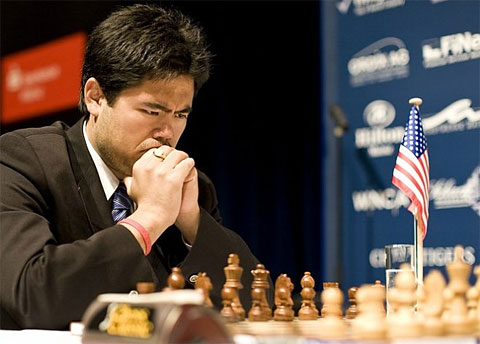
Hikaru Nakamura, 2-time US chess champion, Grandmaster

"If you cannot measure it, you cannot improve it" once said Lord Kelvin. I don't think this statement is really totally true in my assessment, but I can certainly see where he is coming from. You certainly need to have a clear, assertive mindset about what you are trying to accomplish and the consistency to get things done. You need to be aggressive, persistent, and resourceful. Here are some goals I have in mind that I plan on accomplishing as well as some details regarding their nature and execution, via the tetrahedral concept:

Athletic/Physical: I need to increase my stamina so that is my main focus as of now. Looking at the big picture, I am trying to maximize all aspects of my body's abilities in a general balanced manner. I do not want to train in such a way as to hamper my performance in another area (lose so much weight that it hurts my strength even as it dramatically improves my stamina for example) but an ideal maximal balance must be struck. I do not have any strong preferences in regards to the areas of strength, speed, stamina or agility. I think I shall focus on the best balance overall. At present time, I intend to increase my performance capabilities in all areas (perhaps with emphasis on stamina since this is a weak point). I want to be as strong as a football player, swift as a badminton player, as energetic as a soccer player, and as dexterous and coordinated as a ballet dancer (collegiate, division II type level). If I can reach that general athletic level then I will consider where to improve from there. By the age of 29 I intend to accomplish this. In order to do this I must exercise regularly and at high-moderate intensity. Serious training must be engaged at least 3 days a week, with mild workouts almost daily.

Intellectual/Mind: Fundamental to this aspect are the mental processes and the enhancement of its general capacity, such as the accumulation of knowledge, the improvement of reasoning, developing mental clarity, practical sense, abstract thinking, problem solving, calculating speed, combining and comparing facts and ideas, the ability to employ or to adapt to new contexts conceptual understandings, the strengthening of memory, and enhancement of creativity, as well as numerous other areas regarding the performance functions of mind and the increase of intellect. There can be found a bit of overlap between some intellectual and moral imperatives, but there is a fine distinction. Displaying restraint and possessing self-discipline in the face of strong emotion is a moral imperative, but understanding the process regarding exactly how this technique is to be achieved is an intellectual imperative. I would say that the prerogative in terms of my description of intellect/mind is that it focuses on how the brain works better and can perform best. I try to be a dynamic thinker, and my main goal in this area (or my main inspiring motivation) is to possess a sharper, more competitive intellect than anyone else. I think I have the talent to produce some exceptional results with the brain I have, and I train in order to build maximally on my natural advantage.

Moral/Social: The moral aspect in the tetrahedral construct comprises not only of personal ethics, but also goals, values, community endeavors, duties, career, family, social involvements, romance, faith and spiritual matters, and the development of wisdom. It may also encompass economic pursuits, the proper execution of social roles or responsibilities such as leadership, and the initiation of missions. Life experience, journeys and struggles, as well as emotions (from romantic to vengeful, nostalgic to visceral) can all strengthen one's moral foundation. It is both individual and introspective as well as goal-related and socially-oriented. It is also the pursuit of dreams, and can include such activities like drafting blueprints for goals that one wishes to achieve. It expresses itself in each individual in their thoughts, feelings, and actions. Overall, perhaps this is the most important aspect of the four.  What are my personal aspirations? That would be too simple to list, and I know them all clearly enough already. My work is to ensure that I do what I need to do, and go at the world everyday at 100% power.

I have already listed my Skills/Capabilities goals in my notebook, so it is not necessary to repeat that file here. I am not sure if a rigid, exact, detailed schedule can effectively be implemented on a daily basis, though it is certainly the case that I must have a clear idea of what I am going to do everyday, by the week, by the month, and so on. The goals I have come up with and the plans that I have devised must be resolutely stuck to, unless of course I am presented with a necessary change of plans, based on the continuing circumstances.

Sunday, October 30, 2011

Beautiful Architecture

Beautiful architecture inspires me. When I see a well-built and aesthetically attractive building a feeling wells up within me. It is like a kind of mellow happiness and a sense of appreciation rolled up into one emotion. That is why I have chosen Architecture as a field of study in my skills to train in list. I also wanted to add something creative or artistic to my skills list so that I had a plan that was more well-rounded. After all, those great Italian renaissance men all had highly developed artistic backgrounds. Not that I would compare myself to someone possessing the magnitude of talent of Leonardo Da Vinci, but nonetheless I do intend to pursue training in this field in order to see what I can do. Architecture is an area where I have passion as well as perhaps some potential for. So, even assuming that I will never be able to match Andrea Palladio in sheer ability, I genuinely do believe that I can touch that wonderful divine essence of beautiful architecture in some new piece, a setting, a building, somewhere at some time in the future. I have some ideas in mind.

Saturday, October 29, 2011

On Poker

A classic game
A game of poker, a universe of possibilities. Like all of the great games of strategy, there is much one can learn from playing this game, many lessons applicable to everyday life. One can access greater insights into the nature of various aspects of strategic thinking. From calculating probabilities intuitively, to psychological manuvering, to plain old step-by-step calculation, to long term future projection, to puzzle solving, there are indeed numerous benefits from the practice of these games.

My personal pick goes to poker. A very subtle game, fairly tough to master. It is not immediately obvious how to win at this game, and it has quite a steep experience curve one usually needs to attain before becoming very good at it. I say experience curve rather than learning curve because it seems to me that poker is much more reliant on actual play experience as compared to some other games. You can learn all of the tactics and positions regarding chess from books, but in poker the books are usually not as helpful, mainly because of the nature of the game. Poker is defined mainly by general rules of thumb, few absolutes, and requires lots of decision making, keen opponent observation and in-game tactical adjustments. In comparison, chess can perhaps be considered a simpler endeavor. A computer can beat a world champion chess player, whereas in poker there has never yet been devised a program that can consistently perform at a high rate of success. But then again, world champion poker players can lose at a table of rank amateurs (it happens not that infrequently too), whereas in chess this is extremely rare. It would be considered borderline miraculous if Vishwanathan Anand took on the local high school chess club champ and lost (unless that kid was a reincarnated Tigran Petrosian). So here you have an interesting dichotomy in those two games of chess and poker. Perhaps a new game can be devised which combines aspects of both, or other games of strategy and psychology which test various aspects of the mind going up against other minds or even testing one's own mind (hopefully more challenging than solitaire).


Friday, October 28, 2011

How to Conquer the World

A medieval mongol warrior, artist unknown

In modern times, is it possible to launch a campaign of global domination and succeed? Before the modern era, it seems embarking on a crusade for world conquest was simpler. All you needed were enough hungry men with nothing better to do, horses, weapons, some strategy and leadership and then bingo, that was your base for global domination. Things are more complex now in the modern world. So is world conquest still an achievable goal?

Personally, I think that it may be even more possible to unite the world under one dominion today than it was in the medieval past. With the global network of trade, communication, travel, people, etc., the base of options are wider and opportunities much closer and within reach for each individual. You just need to have the money, knowledge, and connections to make things happen.

So what would be a feasible plan to embark on regarding a mission of conquest? Most dictators for example will stay within their local domain of cultural heritage and you do not see many cross-continental wars occurring post 1950. They seemed to have been cowed by the modern capitalist republics and their military power, which is based on a rich tax source produced by the free market model. But then again, the Soviets had an immense military capacity based on a communist/socialist model. It seems that an aspiring world ruler can operate under either the communist or capitalist system, and can potentially gain power under either a democratic or totalitarian government. Personal preferences aside (mine being democratic and socialist/capitalist), how does one become a ruler of a kingdom of his own, not necessarily a country much less the entire world (my ambitions are aimed at the local kingdom level)?

You need a plan in order to gain a kingdom of your own. In general, you need to amass resources, economic, social, and political (especially economic). Then you leverage all of those resources towards your goal, obviously in this particular case as specified by the premise, which is obtaining rulership of your own "kingdom". Kingdom to me means the sum total of domestic and socio-political power. Domestic power to me means a house (such as a palace complex), land, wealth, ownership of goods, technology and labor (servants, specialized professionals). Socio-political power is control of the social and governmental environment (having a high class rank, possessing above normal legal resources, access to higher education, government influence), also an ability to influence society through religion, media, politics, or business (in the socialist and capitalist societies). So the key is reaching a certain level in these fields in order to be able to do those various things you have in mind.

When you have a complex plan, it is often the case that you need to do something else before you can do the big plan, first by reaching a medium step, and then to take that medium step, you have to execute a smaller plan first. It is like trying to reach the top floor from the lobby, you have to get to the in-between floors first, and to do that you have to take all of the steps in between to reach the next floor, hence you can climb to the top. This is assuming that it is not possible to jump that far from where you are at, if this is not the scenario you find yourself in, then by all means take the leap for it. 

To answer the premise of this entry, "How to Conquer the World", my answer is this, that it seems unlikely to me that I can achieve even a kingdom (which is my goal) if I do not first attain a huge fortune (living in a mainly capitalist republic). I do not have an exact plan for how to do this as of yet, and my current resources, training, education, and status are all at a novice level. But I am working on this and making progress.   

Wednesday, October 26, 2011

Mastermind a Plan

                                                                        (The mind: powerful and mysterious)

A plan. You should always have one, at least in of all of the major or important aspects of your life. Having a plan doesn't mean that you possess the perfect blueprint for success (if such a thing is even possible to create in complex and fluctuating situations). What it does mean, though, is that you come to the table prepared, much more ready and formidable than if you had no plan whatsoever. So plans are good, even great to have in place, as compared to the alternative.

Now, there are 3 phases in regards to any plan. Phase 1: Make the plan. This implies that you have some understanding of the situation, the possibilities involved, and what options you can bring to bear on the task at hand. You employ your problem solving skills here, which is your Method, your creativity and resourcefulness, as well as logic and calculation. Try to be accurate, but of course you should not honestly expect perfection. Try to take account of all of the variables, the possible twists and turns, and develop a back-up plan whenever feasible. Phase 2: Enact the plan. This part should be obvious, but definitely needs reiterating because the simple fact of the matter is, if you do not execute the plan that you have spent time and effort devising, then why did you even bother to create one in the first place? It requires discipline, resolve, and consistency in work habit to start a thing and finish it. This applies to your planning as much as anything else. If you have a plan, please execute it, even if (especially if) it requires a big ballsack to get the job done. Phase 3: Evaluate the results. You know, observe what happens and take mental note of how it all went down. You do this automatically of course if you just pay attention in your life in general. It is a learning process. You learn from experience. If you commit errors, you do better and become stronger for the next round. And it's as simple as that. If you need to adjust or change your approach, then good, do whatever it takes.

A question I have asked myself before is whether thinking or action is superior. We recognize that they are both important, but morally and logically, is one superior to another? By nature I am more a thinker. But action is where the rubber meets the road, where goals get met, where dreams become realized. So, based on this fact, I am somewhat envious of those who are action-taking dominant. It is an aspect of myself that I must strengthen.

Friday, October 21, 2011

Martial Arts Mastery


What are the keys to mastering the martial arts? Regular training, dedication to improvement, and real competition. By real I mean as close to actual combat as possible, without risking serious and life-threatening injuries. I think that is an Achilles heel with many of the martial arts today, there is sometimes a disconnect between the techniques that are taught and practiced and what will actually work in a real fight. The nature of fighting at its core is about taking out your opponent, through effective and efficient techniques. It is an art and a science, and it can be serious business. So in training, one of the aims for practitioners should be to put themselves in as close a situation as feasible to the real thing, in as much varieties and combinations as they might encounter in street situations and what have you. One interesting area that hardly any martial arts seem to include is the prospect of fighting multiple opponenets at the same time. I remember I had an Ashihara Karate book that maybe had something in there about fighting multiple guys, but that is the only reference that I have come across from a reputable practitioner that had suggestions on that situation. I wonder why there isn't more instruction on how to deal with that scenario when it arises.

Developing one's fighting capabilities is clearly a necessary and advantageous thing to do, at least from my perspective. There are certain martial arts that seem to be much more reliable in generating that ability, such as muay thai and brazilian jiu-jitsu. As of present times though, there is a great deal of experimentation among the best practitioners to try out new techniques or to improve existing approaches.

The athletic aspect cannot be ignored. You can be physically weaker and slower than someone else and still dominate a fight if you know what you are doing and have superior training, but nonetheless you do want to strengthen your athletic capabilities in order to carry that power into your fighting.

Thursday, October 20, 2011

Metistonic Man

                                                                                    (The samurai ideal)

So what is metistonic man? That is the question I will try to answer in this article. He is not a samurai, or conquistador, or shaolin monk, or scientist exactly, or even a renaissance man. He is rather the combination of many aspects of these types, forming a new type for the modern world. I would describe an idealized set of characteristics by using the following words: ambitious, yet principled, competitive, yet selfless, physically gifted, intellectually gifted, and exceptional generally.

I will provide some hypothetical examples of what metistons should generally be like, mostly in terms of what they do: Metsiton Guy 1-Winner of an Olympic bronze medal in water polo. Active in boxing, having an extensive amateur career as well as a few professional fights before deciding to focus on coaching. Plays backgammon. Paints semi-professionally. Has an MBA from Stanford. Has his own business in renewable energy solar panel and windmill manufacture (with order funding and involvement). In semi-retirement, lives in Honduras working with the order on various missions (mainly charity related) and coaches new disciples in boxing skills. Metiston Guy 2: Decides to join the metisonic order as a young man. He qualifies, passing the tests and evaluations and by performing the duties and achieving tasks, gaining full membership at age 22, after only three years. Started a non-profit to prevent malnutrition in children in India. He likes track sprinting, training in it intensively but not wining any top flight competitions. He can outrun all the other members in his regional HQ except for one guy, the current metistonic champion in running. He can speak 3 foreign languages. Has a BS in Computer Science. Does computer work, and much of the training (as well as funds to pay off his student loan) comes from the order. Metiston Guy 3: Former green beret, looking to do more in life after the military. Looking for a group of ambitious men to join. Applies his military training for the benefit of the order, and in return gains resources (legal, medical, social, etc.), and through performing some necessary missions earns land and money. Has a BA in History. Is a competing triathlete. Picks up the plumbing trade. Learns many skills from the order. Actively participates in recruiting campaigns for the order.

On some other key points and musings:

An interesting question is how to rank mastery or quality in the arts, sciences, and other areas if a clear objective system is not in place. For example how would one determine who the best authors or architects are? It is key to know how good the level of capability and performance is in all the various fields, athletic, intellectual, technical, and artistic, for comparison purposes.

It is quite important, in everyday life, for one to figure out if what they are doing is anywhere near their actual capacity. Can you achieve more, and do more, or are you operating under a low bar or limiting pretenses? Find out, and fix it when necessary.

As a society we need to encourage amateurism in all fields. Adult training, continued learning, certifications and competitions for non-professionals are all highly beneficial for a society.

The Order is about overcoming limitations. It is usually the case that failure or success is a matter that is largely chosen by the individual and his own consistent actions, or lack of them. This does not wholly apply in the case of competition against others, but in the case where there is no force or intelligence actively acting against you,the matter of success is very largely in one's own hands. There is the imaginary supreme model that all mestistons can look up to, maybe call him "granda oni", perfect in wisdom, morals, intellect, athletically supreme, an Adonis and a Daedalus in one man. "The big thing about Batman is the he is the ultimate generalist. That is, he has well-rounded ability in just about everything but isn’t the best at anything except being Batman. So, in the context of what Batman can teach about training, it means train to be very good at many things. Diversify in your training in order to specialize in being you.", is the quote from an interview of E. Paul Zehr. His book on batman training was quite misleading and was really about human physiology, but this quote he made is a good one. Nature has provided us with the tools to overcome her.

Fun activities, sports and challenges that men can do in a group should be on the schedule at HQ.

Oh, and what does the official flag for the order look like? So far I am thinking about a triangle with a circle at each point, representing the triumvirate goddess of order, nature, reason. Maybe she could be called "The Lady of Reason". "The difference is, our gods are real", can be an oft-used phrase in signifying the contrast to other religions. And also, some kind of technologically customized platinum/diamond medallion or ring can be given to each metiston upon his entrance into full membership status.